
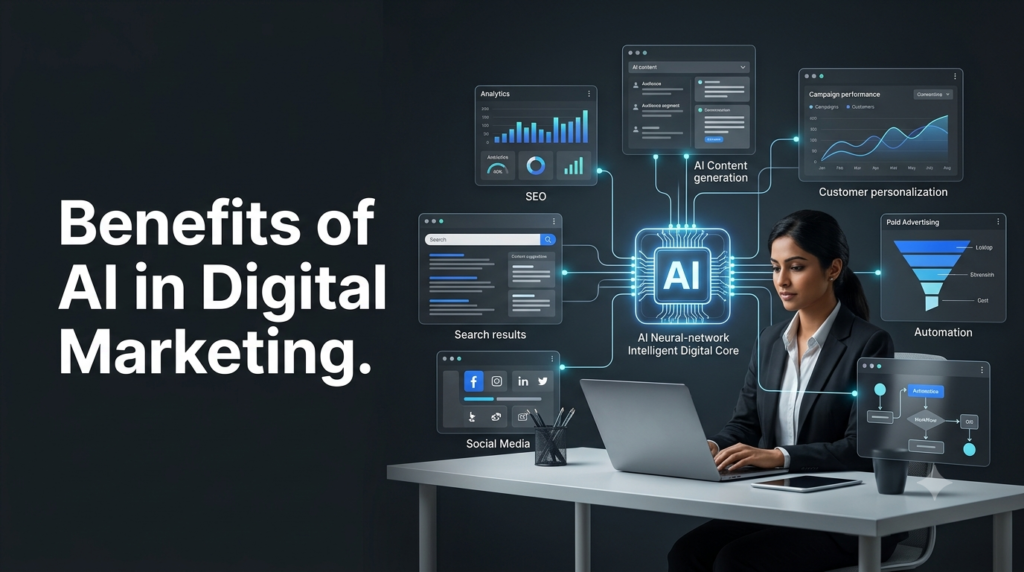
Artificial intelligence is changing the way businesses approach digital marketing. From creating content and analysing customer behaviour to improving advertising and automating repetitive tasks, AI is helping marketers work faster and make more informed decisions. Understanding the benefits of AI in digital marketing can help businesses use these technologies without losing the creativity and human connection that good marketing needs.
AI is not limited to chatbots or content generators. It can support almost every stage of the marketing journey, from understanding a potential customer to measuring the performance of a campaign.
What Is AI in Digital Marketing?
AI in digital marketing means using artificial intelligence to support marketing activities such as content creation, customer analysis, advertising, SEO, personalisation, and automation.
For example, an online store can use AI to study what customers view and purchase. A marketer can use those insights to create more relevant product recommendations or campaigns.
Some common uses of AI include:
- Content and ad copy creation
- Customer behaviour analysis
- SEO research
- Campaign optimisation
- Email personalisation
- Chatbots
- Data analysis
- Marketing automation
The goal is not to automate every marketing activity. Instead, AI can handle repetitive work while marketers focus on strategy and creative decisions.
Why Are Businesses Using AI in Marketing?
Modern businesses collect information from websites, social media, advertising platforms, emails, and customer interactions. Reviewing all this information manually can take considerable time.
AI can process large amounts of data quickly and identify useful patterns.
For example, if a business notices that many people click an advertisement but very few complete an enquiry form, AI-assisted analysis can help identify patterns in the campaign data. The marketer can then investigate the reason and decide what needs to change.
This shows the importance of AI in digital marketing: it can support faster analysis and better-informed marketing decisions.
Benefits of AI in Digital Marketing
1. Saves Time on Repetitive Tasks
Marketers spend a lot of time on tasks such as preparing reports, creating basic drafts, organising information, and generating content ideas.
AI can assist with these activities and reduce manual work.
For example, a marketer can use AI to create an initial social media content plan and then edit it according to the brand’s audience and goals.
This gives marketers more time for analysis, creativity, and customer research.
2. Helps Understand Customers
Understanding customer behaviour is essential for successful marketing.
AI can analyse information such as website visits, purchase history, email engagement, and social media interactions.
These insights can help marketers identify what customers are interested in and where they may be facing problems.
Instead of relying only on assumptions, marketers can use customer data to support their decisions.
3. Improves Personalisation
Customers are more likely to respond to content that feels relevant to them.
AI can help businesses personalise emails, product recommendations, advertisements, and website experiences based on customer behaviour.
For example, an ecommerce website can recommend products based on what a visitor has previously viewed.
This allows businesses to create more relevant experiences without manually creating a separate campaign for every customer.
4. Supports Content Creation
AI can help marketers with blog ideas, social media captions, video scripts, headlines, email drafts, and advertising concepts.
However, AI-generated content should not simply be published without review.
Marketers still need to check facts, add original ideas, understand the audience, and maintain the brand’s voice.
AI can provide a starting point, while human expertise improves the final result.
5. Helps Optimise Advertising
Digital advertising involves decisions about audiences, budgets, creatives, keywords, and campaign performance.
AI-powered systems can analyse campaign signals and help marketers identify which elements are performing well.
For example, if several advertisements are running at the same time, AI can help identify patterns in their performance.
The marketer can then use those insights to decide where further testing or optimisation is needed.
6. Makes Data Analysis Easier
Marketing data can come from many different sources, making it difficult to understand the complete picture.
AI can help organise and summarise large amounts of information and highlight possible trends.
Marketers can use these insights to investigate questions such as:
- Which content is getting attention?
- Where are visitors leaving the website?
- Which campaigns are generating enquiries?
- What questions are customers asking repeatedly?
AI can make the data easier to understand, but marketers still need to check the information before making important decisions.
7. Improves Customer Support
AI chatbots can handle common customer questions at any time.
They can provide information about products, services, business hours, bookings, orders, and other frequently asked questions.
This can reduce waiting time for customers while allowing human employees to focus on more complicated situations.
The best approach is often a combination of automated assistance and human support.
Will AI Replace Digital Marketers?
Will AI replace digital marketers? is a common question as AI tools become more capable.
AI can automate many repetitive tasks, but digital marketing involves more than task completion.
Marketers need to understand customers, develop strategies, create brand messages, evaluate campaigns, and make decisions based on business goals.
For example, AI can generate several advertising ideas, but a marketer needs to decide which message fits the brand and target audience.
This means the role of the marketer is evolving. Instead of spending most of their time on manual tasks, marketers can use AI to assist with execution and spend more time on strategy, creativity, and customer understanding.
Future of AI in Digital Marketing
The future of AI in digital marketing is likely to involve deeper integration between AI tools and everyday marketing platforms.
Some areas that may continue to grow include:
- AI-powered customer personalisation
- Conversational marketing
- AI-assisted video creation
- Predictive customer analysis
- Automated reporting
- AI-powered marketing workflows
- Voice and visual search optimisation
As these technologies develop, marketers will need to learn how to use them effectively while maintaining human oversight.
How Can Marketers Prepare for AI?
Marketers do not need to learn every AI tool available. A better approach is to start with practical problems.
First, identify repetitive tasks that consume time. Then choose an AI tool that can assist with one of those tasks.
Marketers should also develop skills that AI cannot simply replace, such as:
- Strategic thinking
- Creativity
- Customer understanding
- Storytelling
- Critical thinking
- Brand communication
Learning how to use AI and evaluate its output will become an important part of modern digital marketing.
Final Thoughts
AI is changing digital marketing by helping businesses analyse information, automate repetitive work, personalise communication, create content, and improve campaigns.
However, AI alone does not create successful marketing.
Businesses still need strong strategies, useful products or services, creative ideas, and genuine customer understanding.
The most practical approach is to combine AI’s speed and data-processing ability with human creativity and judgement.
AI can help marketers work faster, but human thinking gives marketing its direction.